- by 46 Tattoo
Geometric Sleeve Tattoos: A Complete Guide
- by 46 Tattoo
Geometric tattooing goes back thousands of years. The modern sleeve version is one of the most technically demanding styles in the industry.

Geometric patterns have been tattooed onto human skin for thousands of years. Polynesian cultures developed some of the most sophisticated systems of geometric body art ever recorded, with Maori ta moko and Samoan pe'a using interlocking forms to communicate identity, lineage, and social standing. In ancient Egypt, geometric tattoo fragments have been found on mummies dating back to 3000 BCE. These weren't decorative. They were structural languages.
The modern geometric tattoo movement emerged in the late 2000s, when a wave of artists began combining these ancient influences with sacred geometry, architectural drafting, and digital design aesthetics. Dot work technique, imported from stipple printmaking, gave geometric tattoos a texture that suited the precision of the style. By the early 2010s, geometric sleeves had become one of the most technically demanding categories in tattooing.

Geometric tattooing is built on precision. Lines need to be consistent. Angles need to be accurate. Dot gradients need to flow evenly from dense to sparse. A geometric sleeve that lacks technical control reads immediately as messy, because the style has no organic looseness to hide behind.
At sleeve scale, the main design challenge is flow. Individual geometric panels look striking on their own, but a sleeve requires the whole arm to read as a unified field. The best geometric sleeves use consistent line weight, a repeating motif or grid system, and negative space as a structural element rather than empty area.
Geometric sleeves usually fall into one of three approaches, though many combine elements of all three.
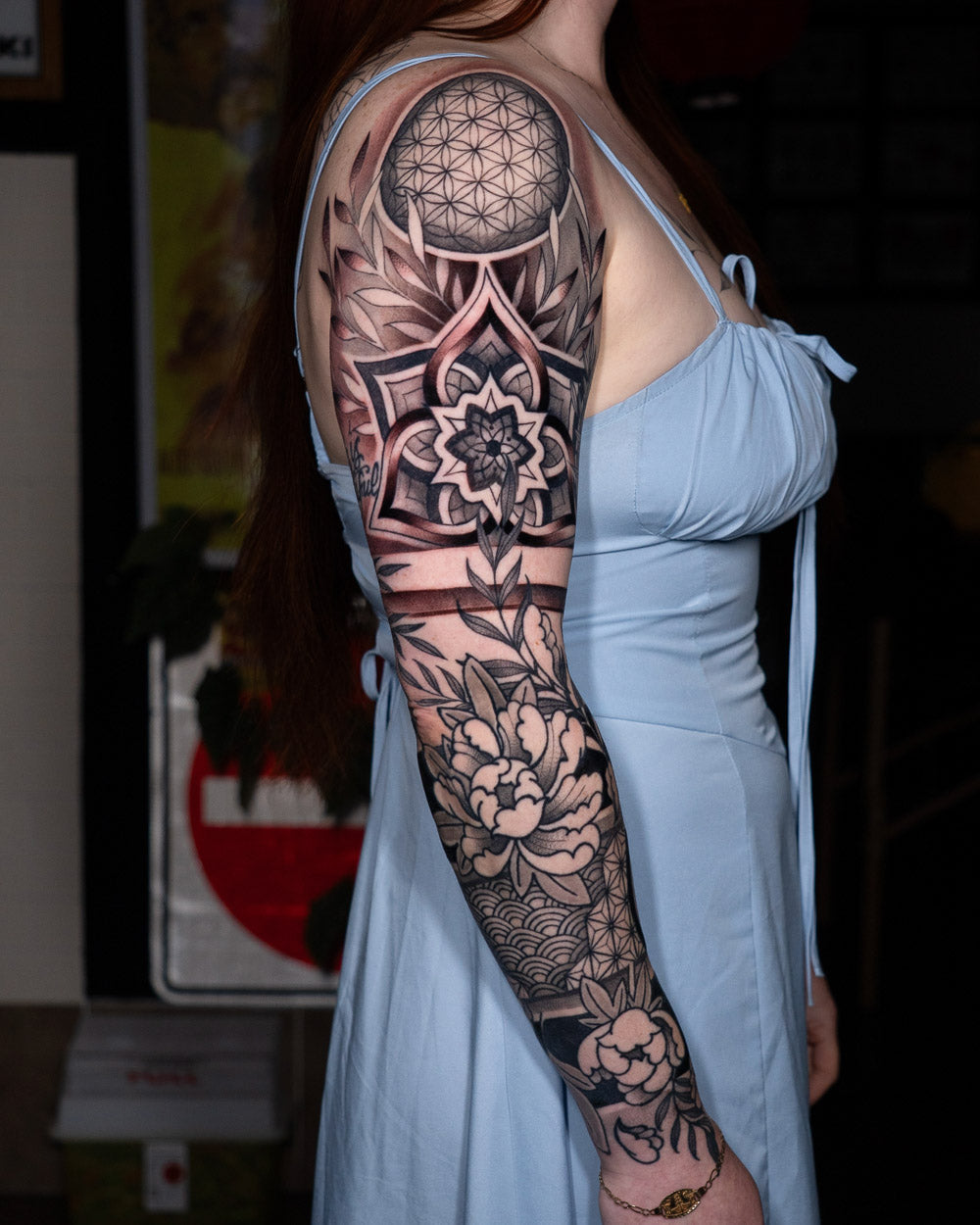
Sacred geometry uses shapes with symbolic weight: the Flower of Life, Metatron's Cube, the Fibonacci spiral, platonic solids. These forms have been used across cultures for centuries as representations of universal order. A sleeve built around sacred geometry tends to feel intentional and layered with meaning.
Mandala-based sleeves use radial symmetry as their organizing principle. A central mandala anchors the shoulder or forearm, and the surrounding geometric patterns echo its form outward. The challenge with mandalas at sleeve scale is maintaining symmetry as the design wraps around a three-dimensional arm.
Abstract geometric sleeves use interlocking shapes, triangles, hexagons, and line work without a single symbolic reference. These tend to feel more contemporary and architectural, closer to graphic design than spirituality.
Geometric sleeves are among the more time-intensive sleeve types because the technical precision required means slower, more deliberate work. A dense dot work sleeve takes significantly longer per square inch than bold-outline traditional work. Sessions run 6 to 10 hours based on your comfort. Cost is by the hour.
What adds time:
Reach out for an estimate. Geometric work varies more than most styles based on density choices, and a short conversation will give you a much more accurate picture than any range we could publish here.