- by 46 Tattoo
Black and Grey vs Colour Sleeve Tattoos: Which Should You Choose?
- by 46 Tattoo
The choice between black and grey and colour affects aging, session time, maintenance, and which styles are even available to you. Here's how to think through it.

The choice between black and grey and colour isn't just aesthetic. It affects how long your sleeve takes to complete, how it ages over the next decade, how much maintenance it requires, and which styles and subjects are available to you. Most people make this decision based on what looks good in a reference photo. The more useful way to make it is to understand what each approach actually involves.
Black and grey tattooing uses diluted black ink to create a full tonal range from deep shadow to near-white highlight. The technique has roots in Chicano prison tattooing of the 1970s, where artists worked with limited materials and developed an expressive, photorealistic approach using a single pigment. By the 1980s it had moved into professional studios, and today it covers everything from hyperrealistic portraits to loose illustrative work to Japanese-influenced pieces.
At sleeve scale, black and grey has three practical advantages. First, it ages more predictably. Without colour pigments that fade at different rates, the piece tends to shift as a unified tone rather than patching unevenly. Second, it requires less healing time between sessions because there's no colour packing. Third, it suits a wider range of skin tones, since black and grey contrast is consistent across different skin.
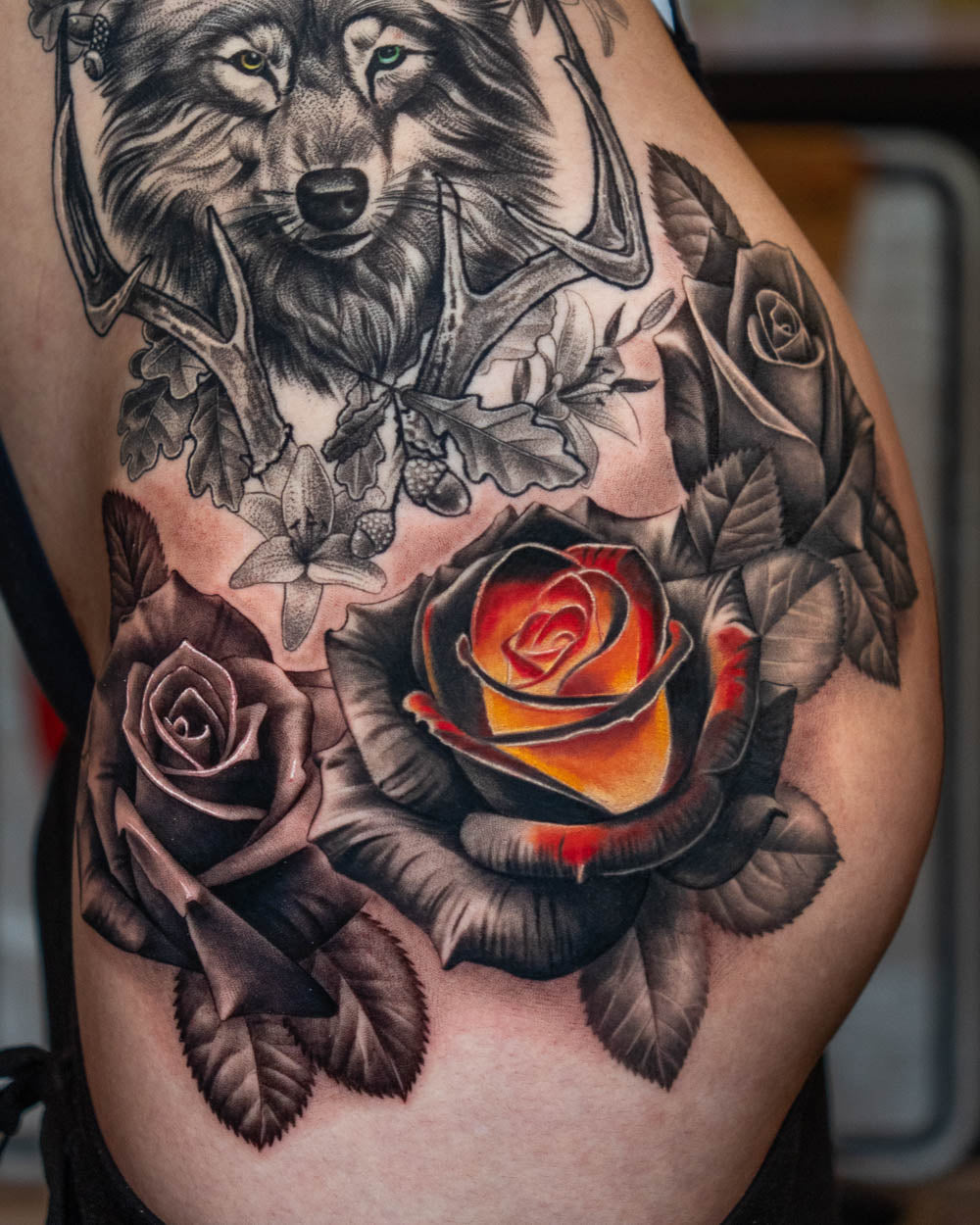
Colour tattoos capture vibrancy, cultural specificity, and visual warmth that black and grey simply can't replicate. A Japanese sleeve with full red and green colour packing looks fundamentally different from the same design in black and grey. Anime sleeves that rely on character-specific palettes lose something essential without their colour. American Traditional without its red and yellow fills is a different aesthetic entirely.
Colour also creates visual hierarchy in complex compositions. Warm tones advance, cool tones recede. A skilled colourist uses this to direct the eye across the arm in a way black and grey can't achieve through tone alone.
The tradeoffs are real though. Colour pigments fade at different rates, so a sleeve that looks vivid at year one may need touch-ups at year five. Lighter pigments, especially whites, yellows, and pastels, fade fastest and need the most maintenance. Sun exposure accelerates this significantly.
Start with the style. Some styles are defined by colour and lose their identity without it: American Traditional, anime, neo-traditional. Others are defined by tone and rendering: realism, fine-line, chicano. If your style has a strong colour identity, colour is probably the right call.
Then consider your lifestyle. If you work outdoors or spend significant time in the sun without covering your arms, colour will fade faster. If you're not prepared to do touch-ups every few years, black and grey will hold up with less intervention.
Finally consider your skin tone. Certain colour pigments, particularly light pinks and pastels, show differently on darker skin. Your artist will advise on which pigments work best for your specific skin.
Both approaches are charged by the hour. Colour sleeves generally take more total time because colour packing requires more passes over the same area, and the skin needs longer between sessions to fully heal. Black and grey sleeves tend to progress faster per session.
What affects total time for either:
Reach out to discuss your specific vision and we'll give you an honest estimate for both options.