- by 46 Tattoo
10 Black and Grey Sleeve Ideas That Actually Work on the Arm
- by 46 Tattoo
Black and grey dominates sleeve work because it ages well and works across almost every subject. Here are ten directions that actually hold together at full arm scale.

Black and grey became the default choice for ambitious sleeve work for a practical reason: it ages better than almost anything else. A black and grey sleeve from ten years ago, properly cared for, still reads with depth and clarity. A colour sleeve from the same period often needs significant touch-up work to look the same way. For a project that takes months to complete, longevity matters.
The style also has an unusually wide range. The same technique that produces hyperrealistic portraits produces loose illustrative landscapes and tight Japanese-influenced compositions. That versatility is why black and grey suits almost any subject or theme at sleeve scale.
1. Realism portrait sleeve. A series of portraits, family members, a deceased pet, cultural figures, anchored by connecting atmospheric elements. Works best when the portraits share tonal consistency and the connective tissue (smoke, clouds, foliage) is designed as part of the plan rather than added as afterthought.
2. Japanese black and grey. All the traditional Japanese elements, dragon, koi, phoenix, waves, peonies, clouds, rendered in black and grey instead of colour. The compositions are built for sleeves and the subject matter fills arm-scale coverage naturally. One of the strongest black and grey sleeve formats.
3. Dark nature sleeve. Dense botanicals, moths, skulls, ravens, and organic forms rendered with heavy contrast. Works particularly well with a gothic or woodland aesthetic. The organic subjects give the artist flexibility to fill negative space naturally.
4. Mythology sleeve. Greek, Norse, or Japanese mythology built as a narrative across the arm. Zeus on the shoulder, Poseidon at the forearm, a sea creature at the wrist. The narrative structure gives even a piecemeal build a sense of intention.
5. Horror sleeve. Classic horror imagery, film villains, gothic architecture, monster close-ups, done in black and grey where the absence of colour leans into the aesthetic rather than away from it. Horror is one of the few genres where black and grey is actually the more faithful interpretation.
6. Realism animal sleeve. Wildlife portraits built around a consistent theme: predators, ocean creatures, birds of prey. The subjects read powerfully at sleeve scale and black and grey realism handles animal texture, fur, scales, feathers, exceptionally well.
7. Fine line botanical sleeve. Detailed botanical illustration with fine linework and minimal shading. Closer to scientific illustration than traditional tattooing. Works best on clients who prefer a lighter visual weight and don't want heavy blacks covering the arm.
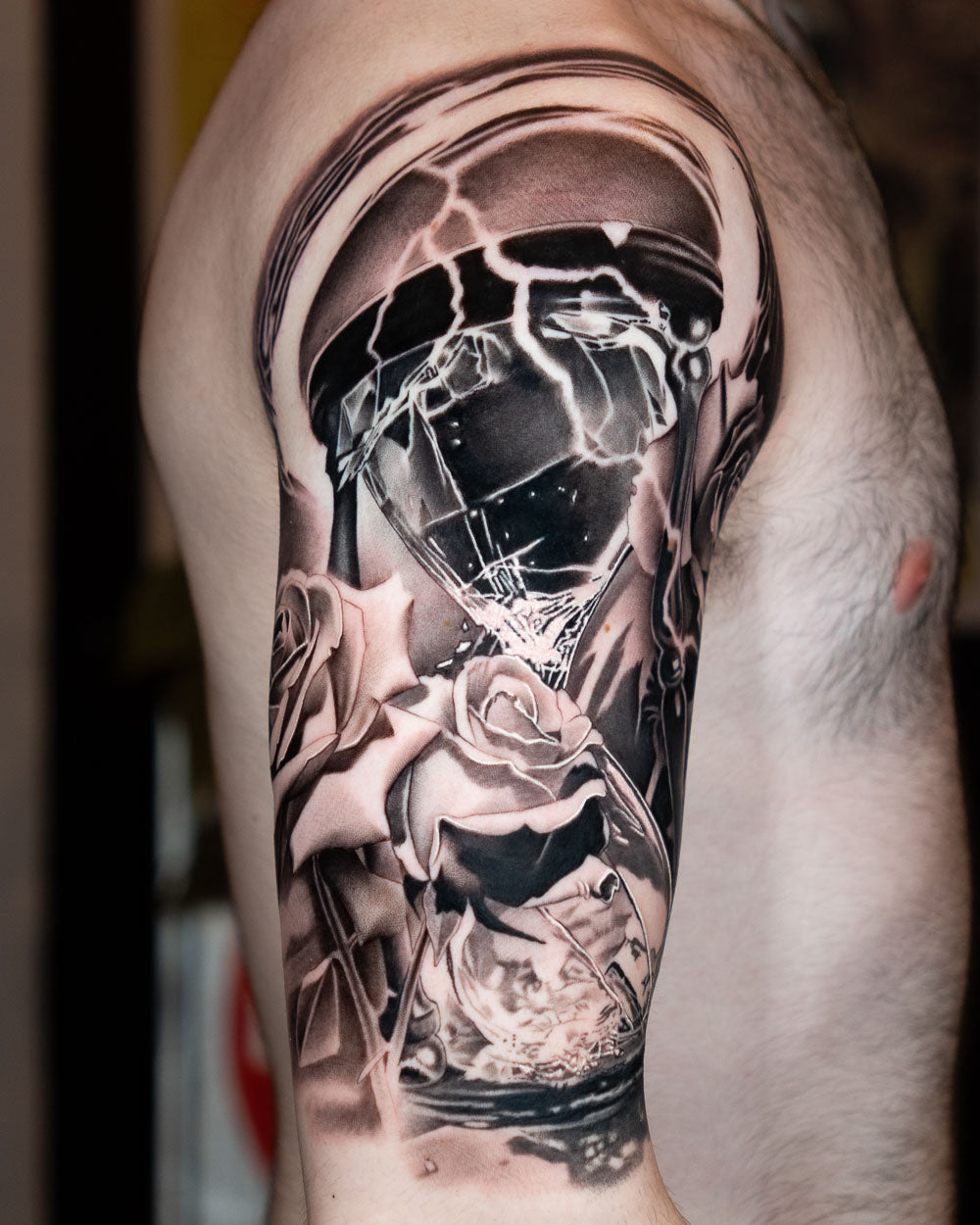
8. Memento mori sleeve. Skull-anchored compositions with clocks, hourglasses, flowers, and symbolic objects arranged around themes of mortality and time. A well-established sleeve concept with strong visual language that has been refined over decades.
9. Cityscape or architectural sleeve. Buildings, skylines, bridges, and structural forms rendered in high contrast. Less common than figurative sleeves, which is part of the appeal. Works best when the architectural subjects are chosen for personal significance rather than generic landmarks.
10. Personal narrative sleeve. No single aesthetic, but a connected set of objects, figures, and symbols that tell the wearer's story. Held together by consistent tonal treatment and a single artist's hand rather than a unified visual theme. The hardest to execute well and often the most meaningful.
Any of these directions can be executed in Toronto. The right starting point is a consultation where you walk through references, discuss which direction fits your arm, and map out how the piece will be built.