- by 46 Tattoo
Anime Sleeve Tattoos: A Complete Guide
- by 46 Tattoo
Anime tattoos had a rough start in North America. Thirty years later the work looks completely different. Here's what to know before planning your sleeve.

The first anime tattoos in North America showed up in the mid-1990s. Dragon Ball Z was on TV. Akira was in video stores. A small group of fans wanted those characters on their skin, and most tattoo artists had no idea how to render them well. The results were often rough. Anime tattoos spent a decade with a reputation for being hard to pull off cleanly.
That changed fast. Naruto ended its run in 2007 with a cultural footprint that reached every continent. Attack on Titan, My Hero Academia, and Demon Slayer turned a new generation of fans into adults with money and an appetite for serious body art. Artists started specializing. Instagram made their portfolios visible worldwide. By the 2010s, anime tattooing had become a legitimate specialty with its own visual standards, its own techniques, and artists who had studied the source material as seriously as any traditional style.
The work coming out of good shops now is unrecognizable from what was possible thirty years ago.
Source material was designed for a screen. Flat colours, fine linework, and facial details that read at 24 frames per second don't translate directly to ink on skin.
A good anime artist doesn't copy. They reinterpret. They find the essential visual qualities of a character and render them in a way that holds up at scale. That's a specific skill, separate from realism or traditional tattooing.
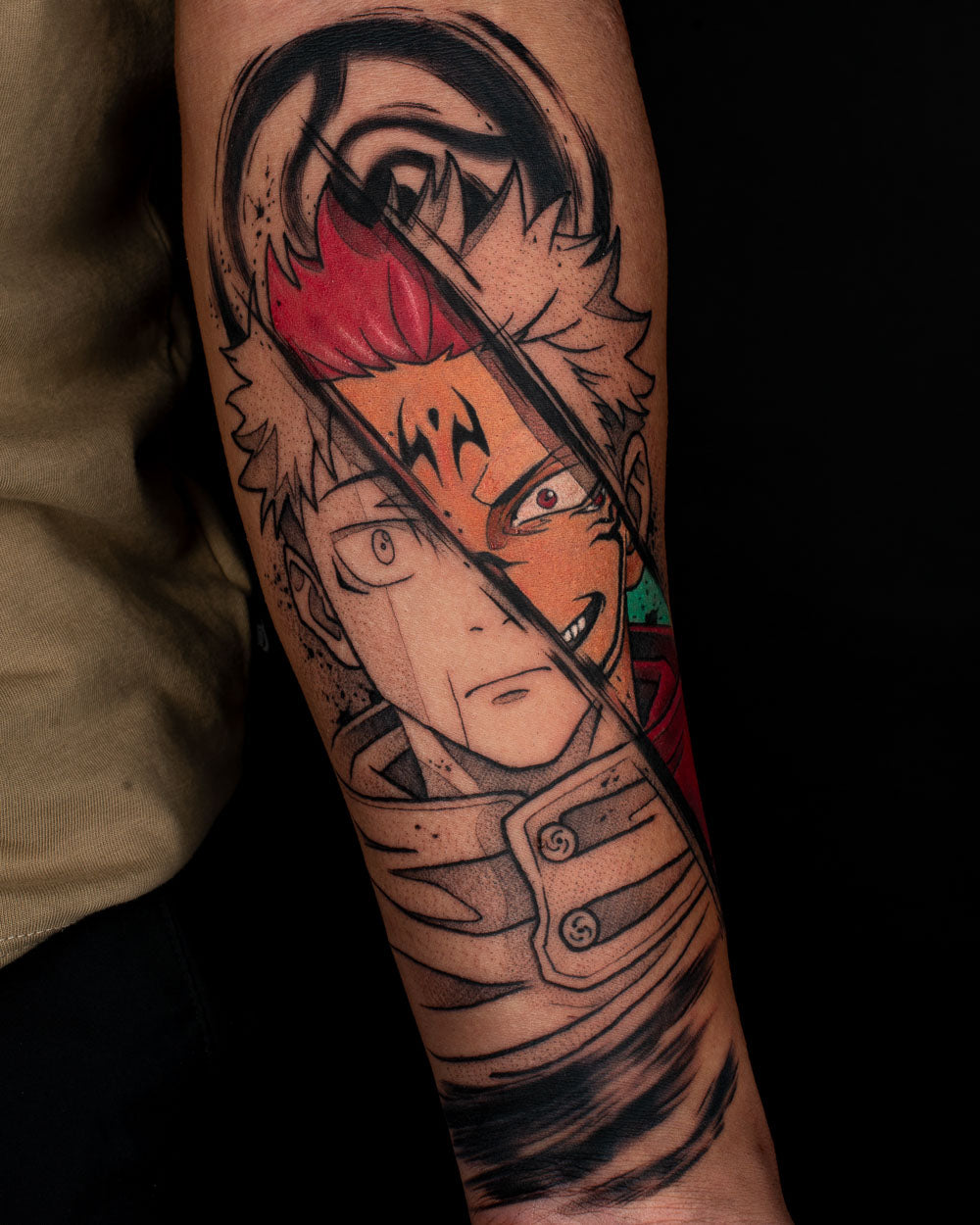
Before booking, look for portfolios with anime work specifically. Strong anime tattooing has consistent outlines, faces that read clearly at the size they're placed, and shading that feels graphic rather than photographic.
Black and grey anime sleeves use linework and tonal shading. They suit darker series well: Berserk, Vinland Saga, the grimmer arcs of Demon Slayer. They also age more predictably and typically take fewer sessions.
Colour sleeves stay closer to the source. The orange of Naruto's jacket. The specific green of Midoriya's suit. The pastel warmth of a Studio Ghibli scene. Colour takes more passes per session and more healing time between sessions, so the overall timeline is longer.
Neither is better. The right call depends on the series, your aesthetic, and how much long-term maintenance you want to commit to.
Single-series sleeves are easier to design. One visual universe gives the artist a consistent look to build with, and scenes can reference each other across the arm. A Dragon Ball sleeve can move from early Goku at the shoulder to iconic fights at the forearm to the Saiyan saga near the wrist.
Multi-series sleeves need a thread. Random mixing reads as disconnected. A strong multi-series sleeve usually has one of the following:
Anime sleeves are charged by the hour. A black and grey character-focused piece takes less time than a dense full-colour sleeve with backgrounds and multiple figures. Sessions run 6 to 10 hours based on your comfort.
What adds time:
Reach out with your series and scope for an actual estimate. Fair warning: our artists are fans. Expect the consultation to run a little long because someone will have opinions about the Marineford arc.