- by 46 Tattoo
American Traditional Sleeve Tattoos: A Complete Guide
- by 46 Tattoo
American Traditional sleeves can be built piece by piece or designed as one full project. Here is what to know about the style, the history, and how to start.

American Traditional is the original North American tattoo style, and its history runs deeper than most people realize. Martin Hildebrandt opened the first professional tattoo parlor in New York City in 1846, tattooing Union and Confederate soldiers with patriotic imagery during the Civil War. By the 1880s, Bowery parlors in New York were producing flash sheets that would be copied up and down the East Coast. Samuel O'Reilly patented the first electric tattoo machine in 1891, and the style's visual language locked in fast: bold black outlines, a tightly controlled color palette of red, yellow, green, and black, and subject matter drawn from sailor culture, folk mythology, and American iconography.
Norman "Sailor Jerry" Collins refined the style further in Honolulu from the 1930s through the 1970s, pushing technical precision and tightening the palette. He codified American Traditional, but the style was already 90 years old by the time he picked up a machine. That depth of lineage is part of why the aesthetic holds up so well on skin: it was built by trial and error across generations of artists and thousands of bodies.
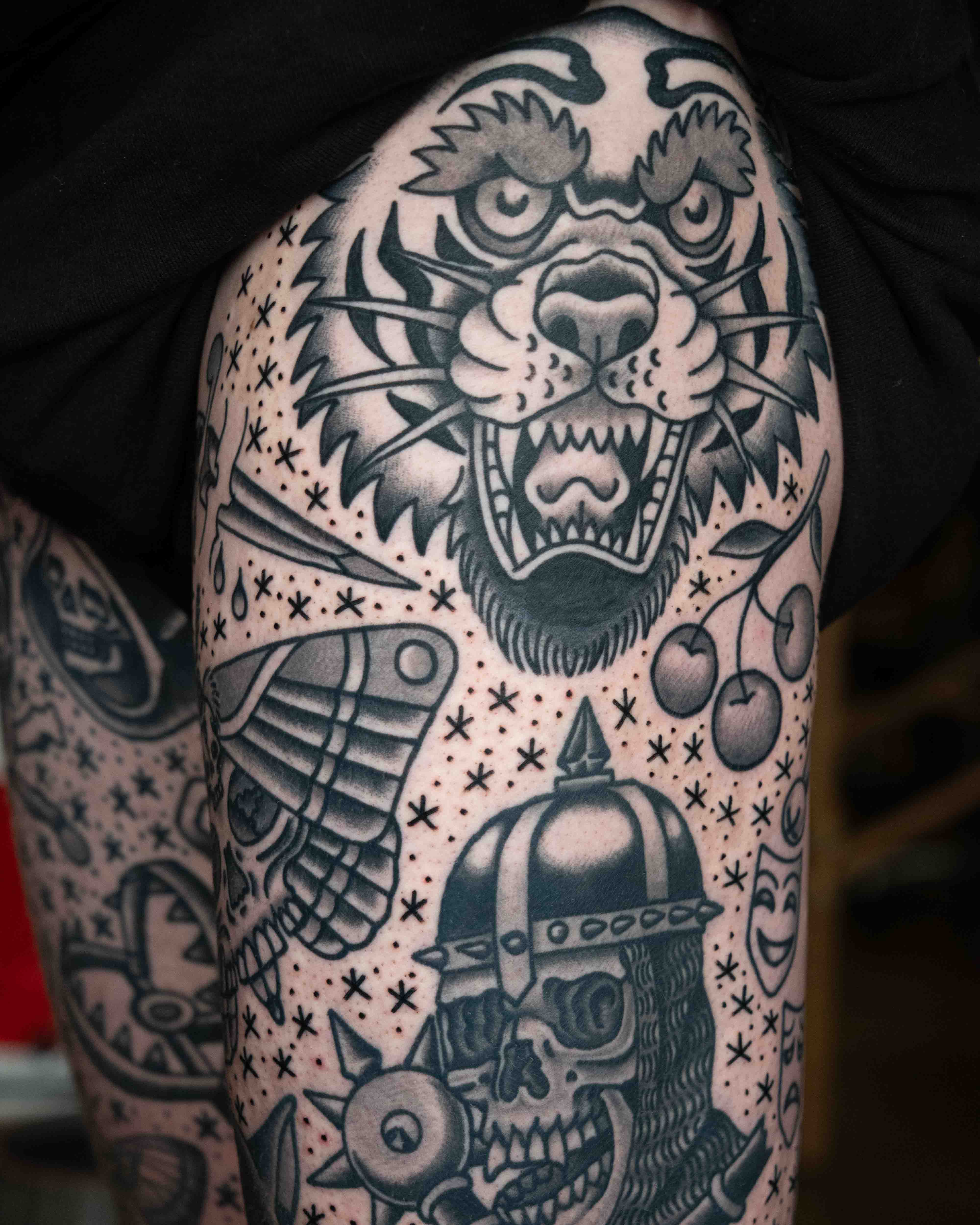
Three things define American Traditional technically. First, the outlines: black lines at 3mm or thicker that hold their shape and stay readable for decades. Second, the palette: solid fills of red, yellow, green, and black with minimal blending. Third, the composition: each design is self-contained, with a clear visual boundary and subject that reads cleanly on its own. That third quality is what makes American Traditional uniquely suited to sleeve builds, because individual designs can be added over time without the whole arm needing to be planned upfront.
American Traditional sleeves are built one of two ways, and which approach fits you depends on where you are starting from. If you already have a few pieces on your arm, the most natural path is patchwork: adding new individual designs over time to fill and connect what you have. If you are starting with a bare arm and want a full sleeve, your artist will design the whole composition first, then execute it across multiple sessions. Either way, the style's modular structure means every design works independently while reading cohesively as a set.
Classic subjects anchor American Traditional sleeves. These are the motifs that were refined over a century of flash culture into their most graphic, readable forms:
At 46 Tattoo, sleeves are charged by the hour and estimated as a whole project, not piece by piece. Your artist will assess the scope during a consultation: how many designs, their size and complexity, whether you want full color or black and grey, and how much filler connects them. That conversation gives you a realistic picture of total hours before you commit to anything.
Several factors affect how many hours your sleeve will take:
Most clients complete their sleeve over 6 months to 2 years, booking sessions at a pace that works for their schedule and budget. For an accurate estimate based on your specific vision, reach out to the team directly, because every sleeve is different and a short consultation will tell you far more than any number we could print here.
Whether you are filling in a half-finished arm or starting completely fresh, the process begins with a conversation. The team at 46 Tattoo will help you figure out the right approach for where you are starting from, which artist fits your vision, and what a realistic scope looks like for your arm.